
THE FOLLOWING IS A POLITICAL OPINION PIECE WRITTEN UNDER PROTECTION OF THE FIRST AMENDMENT AND SHOULD OFFEND NO ONE INCLUDING THOSE IN POWER BECAUSE THOSE IN POWER ARE CHRISTIANS ACCORDING TO THEIR OWN CONFESSION.
When Wealth Comes at the Expense of Others: Understanding Proverbs 22:16
“He that oppresseth the poor to increase his riches, and he that giveth to the rich, shall surely come to want.”
— Proverbs 22:16 (KJV)
Money has always had the power to influence people. It can provide security, create opportunities, and allow us to bless others. But Scripture also warns us about the dangers of allowing the pursuit of wealth to control our hearts.
Proverbs 22:16 offers a striking warning about the misuse of money and power. It speaks about two very different behaviors: oppressing the poor to become wealthy and giving advantages to the rich. Though these actions may appear different, they share the same underlying problem—a heart that places material gain above righteousness.
The verse concludes with a sobering statement: “shall surely come to want.”
What does this mean for us today?
Wealth Should Never Be Built on Oppression
The first person described in Proverbs 22:16 is someone who “oppresseth the poor to increase his riches.”
The language is direct. This is not simply someone who happens to become wealthy while others remain poor. It describes a person who deliberately takes advantage of those who have less in order to increase what he has.
Oppression can take many forms.
It can involve paying workers unfairly, exploiting someone’s financial desperation, taking advantage of people who lack knowledge or power, manipulating vulnerable individuals, or using authority for personal gain. Sometimes oppression is obvious. Other times, it can be hidden behind contracts, policies, business practices, or seemingly legitimate transactions.
The principle remains the same: profit does not justify exploitation.
The Bible consistently teaches that God cares about how the vulnerable are treated. Wealth itself is not condemned in Scripture, but the pursuit of wealth at another person’s expense is repeatedly challenged.
There is nothing inherently wrong with prospering through honest work. The problem begins when someone decides that another person’s hardship is an opportunity for personal enrichment.
A Christian’s question should not only be, “How much can I make?” but also, “How am I making it?”
The Poor Are Not Opportunities to Exploit
One of the important lessons in this proverb is that a person’s financial condition does not determine their value.
Someone may have little money, limited education, fewer opportunities, or difficult circumstances, but that person still possesses dignity and worth as someone created by God.
When we view people primarily as opportunities for financial gain, we can become blind to their humanity.
The poor can become customers to manipulate, employees to underpay, borrowers to pressure, or people to ignore.
Proverbs 22:16 challenges that mindset.
God’s standard for success is higher than accumulation. How we treat people matters.
A person may gain wealth while damaging others, but Scripture warns that such prosperity is ultimately unstable. What looks like success on the outside can conceal spiritual poverty within.
“He That Giveth to the Rich”
The second half of the verse introduces another troubling behavior:
“and he that giveth to the rich…”
At first, this may seem less serious than oppressing the poor. After all, why would giving to wealthy people be considered wrong?
The issue is not generosity itself. The issue is favoritism motivated by self-interest.
People naturally tend to give attention to those who can benefit them. We may treat influential people differently because we hope they can open a door, provide an opportunity, increase our status, or return the favor.
But biblical generosity is not supposed to operate that way.
Jesus challenged the tendency to love only those who can repay us. God’s people are called to show kindness without making everything transactional.
Proverbs 22:16 exposes a dangerous pattern: taking from those who have little while giving preferential treatment to those who already have much.
It is a reversal of God’s concern for justice.
The Danger of Chasing Wealth at Any Cost
The final words of the proverb are perhaps the most important:
“shall surely come to want.”
This does not necessarily mean that every dishonest person will immediately become financially poor. Scripture does not promise that every wicked person will experience instant financial consequences.
Instead, Proverbs is pointing toward a deeper reality: wealth gained through injustice cannot provide lasting security.
A person can have a large bank account and still be poor in character, relationships, peace, integrity, and spiritual health.
What good is financial success if gaining it requires destroying your conscience?
What does it profit someone to accumulate possessions while losing the trust of everyone around them?
The pursuit of riches can become an endless cycle. The more a person has, the more they may feel they need. Eventually, money stops being a tool and becomes a master.
Jesus gave a similar warning when He taught that we cannot serve both God and money.
The problem is not having resources. The problem is allowing resources to have us.
What Proverbs 22:16 Means for Us Today
This proverb gives us several practical principles for modern life.
First, pursue prosperity honestly. There is nothing wrong with wanting to succeed, build a business, earn a good income, or provide a better life for your family. But success should never depend on taking advantage of someone else.
Second, treat vulnerable people with dignity. Whether we are employers, business owners, landlords, managers, consumers, or simply neighbors, we have opportunities to demonstrate fairness.
Third, examine our motives. Why do we give? Why do we network? Why do we pursue certain relationships? Generosity becomes distorted when it is primarily a strategy for getting something from people who have influence.
Fourth, remember that character is greater than wealth. Money can buy many things, but it cannot purchase integrity. A person’s true riches are found in their relationship with God, their character, their relationships, and the good they are able to do with what they have been given.
True Riches Are Measured Differently
Proverbs 22:16 ultimately challenges our definition of success.
The world may tell us that success means having more—more money, more influence, more possessions, and more power.
Scripture asks a different question: What kind of person are you becoming while you pursue those things?
A fortune built by exploiting the poor is not a blessing simply because it is large. Influence gained through flattering the powerful is not true success simply because it opens doors.
God calls His people to pursue something greater: faithfulness, justice, generosity, compassion, and integrity.
Proverbs 22:16 reminds us that we should never sacrifice people on the altar of profit.
If God has blessed us with financial resources, we have an opportunity to use them responsibly. If we have authority, we can use it to protect rather than exploit. If we have influence, we can use it to lift others rather than simply advance ourselves.
The ultimate question is not merely whether we become rich.
It is whether, in the process of gaining what we have, we remain faithful to God and faithful to people.
Because according to Proverbs 22:16, wealth gained through oppression and self-serving favoritism carries a serious warning: what looks like abundance today can ultimately lead to want.
True prosperity is not simply having more.
True prosperity is having enough—and having the character to use it rightly.
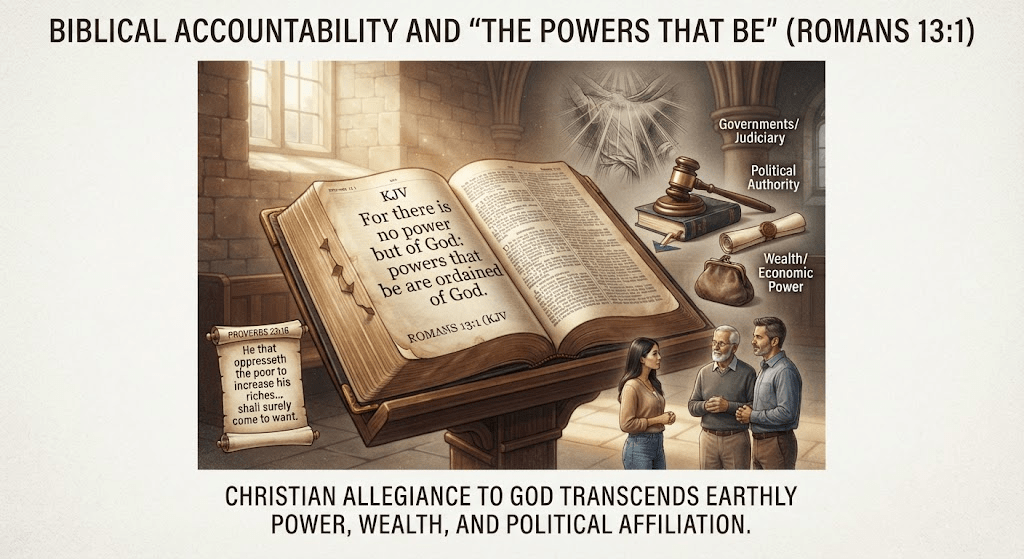
“For there is no power but of God: the powers that be are ordained of God.”
What About “The Powers That Be”?
There is another biblical principle that belongs in any serious discussion of wealth, justice, and power: “the powers that be.”
Paul writes in Romans 13:1 (KJV), “For there is no power but of God: the powers that be are ordained of God.” This passage has sometimes been interpreted as a command to unquestioningly support whoever happens to hold political power. But Scripture itself does not give earthly rulers unlimited moral authority.
Throughout the Bible, God’s people are repeatedly called to speak truth to those who possess power. Prophets confronted kings. Nathan confronted David. Elijah confronted Ahab. John the Baptist confronted Herod. The biblical record does not suggest that political authority places someone beyond moral accountability.
In fact, Proverbs 22:16 gives us a principle that applies precisely because power can be abused.
If the powerful are enriching themselves by oppressing the poor, Christians should not suddenly stop caring about justice because the people doing the oppressing hold political office, possess great wealth, or claim to represent Christian values.
Likewise, if someone gives preferential treatment to the wealthy and influential because they expect political, financial, or social benefits in return, Proverbs 22:16 still applies.
God’s standards do not change depending on which political party is in power.
That is an important point for Christians of every political persuasion. We cannot praise biblical justice when it condemns our opponents and then explain it away when it becomes inconvenient for our allies.
If we believe that the “powers that be” exist under God’s authority, then those powers are ultimately accountable to God. Political leaders are not God. Governments are not God. Wealthy donors are not God. Nations are not God. Political movements are not God.
And neither is any particular ideology entitled to use Christianity as a shield against biblical criticism.
The Christian’s first loyalty is therefore not to a politician, party, movement, or nation. It is to God.
That means Proverbs 22:16 should make every Christian uncomfortable when they see the poor being exploited, regardless of who benefits from that exploitation. It should make us uncomfortable when the wealthy receive advantages simply because they are wealthy. And it should make us uncomfortable when political or economic power is used to justify behavior that Scripture plainly condemns.
The “powers that be” are still subject to the God who gave them their authority.
That is not an argument against government or legitimate authority. It is a reminder that authority comes with responsibility. The greater the power, the greater the obligation to exercise it justly.
For Christians, biblical principles should not be partisan weapons. They should be a mirror held up to everyone—including ourselves.
The Political Cost of Exploiting the Poor
The exploitation of the poor for profit is not only a moral failure; it has serious political consequences. When people with limited resources are treated primarily as opportunities for financial gain, they can become vulnerable to manipulation by businesses, political leaders, and powerful institutions.
Economic exploitation can deepen inequality, weaken trust in government, and create resentment toward systems that appear to protect wealth more than people. When the poor are underpaid, overcharged, pressured into debt, or ignored in public policy, political power becomes concentrated in the hands of those who already have influence.
Proverbs 22:16 challenges this mindset by reminding us that wealth gained through the oppression of others is not true success. A healthy society should measure prosperity not simply by how much wealth is accumulated, but by how people are treated—especially those with the least power.
The poor are not political tools, economic opportunities, or obstacles to progress. They are people created by God, deserving of dignity, justice, and a meaningful voice in the decisions that shape their lives.
THE POLITICAL IMPLICATIONS:
Throughout history, civilizations have experienced political instability when the poor were exploited while wealth and power became concentrated among elites. In ancient Rome, economic inequality contributed to political dependency and conflict. Before the French Revolution, heavy burdens on ordinary people combined with economic hardship and unequal privileges to create widespread resentment toward the government. During the Industrial Revolution, the exploitation of workers eventually led to labor movements and demands for political and economic reform. These examples show that exploiting the poor is not simply an economic or moral problem. When people believe that political institutions protect the wealthy while ignoring those with less power, they lose trust in those institutions, become more likely to resist them, and demand change.

 LINES BY LIMING