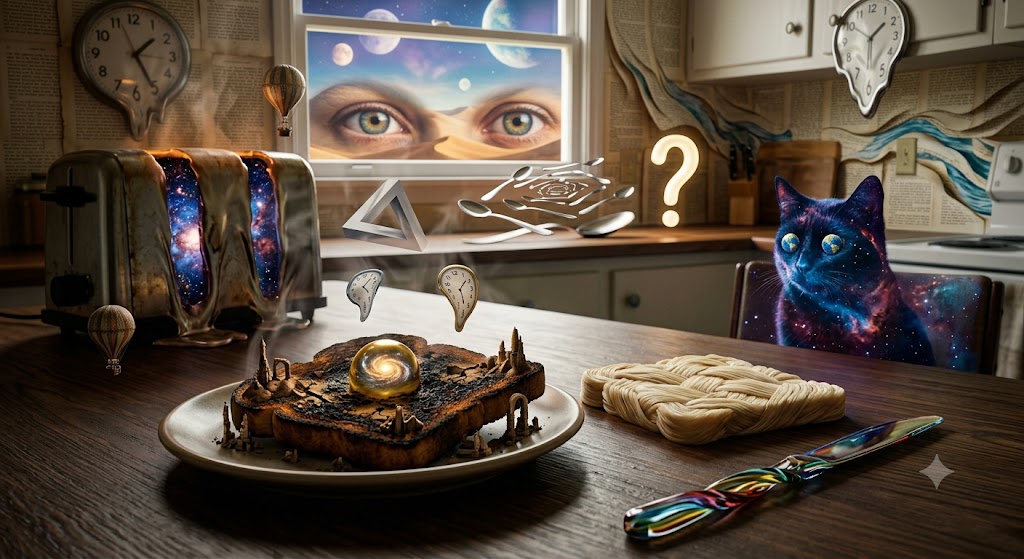
Breakfast arrives not as a ritual but as a slow intrusion of dream matter into the kitchen: a table laid out in the geometry of uncertain time, where knives lean slightly away from their duties and the air itself has been buttered and left too long in the sun.
The pet cat has arrived at the table fully believing that the toast on the plate is going to morph into a nicely cooked fish totally unaware that it is he, himself, who is morphing into a state of dastardly unfulfilled wish dreams.
I place the bread into the toaster and it behaves as though it recognizes me. It speaks and mispronounces my name, “Hi Jerry!”
This is the first mistake.
My name is “John.”
The machine begins to hum in a dialect older than breakfast. Inside its metal ribs, something like daylight is being interrogated. I expect toast—clean, obedient, geometrically domestic toast—but expectation here is only a thin glass window and it is already cracking and cackling at me like a severely contented metal witch.
The scent rises first: not burning, but a collapse of wheat into philosophy.
When it emerges, it is not toast. It is a small charred continent, edges curling upward like melted architecture. The crust has remembered fire in too much detail. It refuses simplicity. It refuses butter. It refuses me.
I hold it anyway.
The cat, now fading into memory and purple mist, softly mews at me.
The kitchen stretches.
The walls begin to soften at their corners, as if painted by a hand that forgot whether it was awake or asleep. A spoon on the counter elongates itself into an anxious question mark. The refrigerator hum becomes the slow turning of an invisible planet.
I attempt correction.
Butter is applied, but the butter behaves like a reluctant memory—it slides across the surface without conviction, sinking into the blackened bread as if into soft ash snow. The toast does not accept it. It absorbs it the way a dream absorbs logic: partially, mockingly, without consequence.
So I surrender the toast.
The butter falls to the floor where what is left of the cat, still evaporating, manages to lap it up at the very point his tail is the only thing left visible.
And I take plain bread instead. — And it screams in terror.
Bread without transformation is a quieter catastrophe. After screaming It sits in my hand like a sentence that never found its verb. I spread butter over it and the butter seems to be watching me back, elastic and slightly aware, as though it remembers being something more elemental before becoming spreadable.
The cat is gone. The smell remains.
It does not walk so much as arrive from a different layer of the room. A visible cloud of fragrant enticing cat essence.
Its eyes are two identical witnesses, perfectly round, perfectly unblinking, like small moons assigned to monitor my breakfast failure. It sits at a distance that feels measured rather than chosen. A scientific distance. A verdict distance.
I chew. The cat sneezes.
The bread has no opinion about itself. This is its cruelty.
The cat, now fully materialized, watches the chewing with the seriousness of a tribunal. I am aware that somewhere behind its gaze, the burned toast continues to exist—not as food, but as a concept that has escaped containment. A blackened idea drifting just above the table, humming faintly like a misremembered alarm clock.
The kitchen bends slightly.
The clock on the wall drips one minute too far, then corrects itself in embarrassment.
Outside the window, morning behaves like a painted backdrop that forgot it was supposed to be cheerful.
I finish the bread and butter.
The cat does not approve. It does not disapprove either. It simply records.
And in that neutrality I understand the final surreal instruction of breakfast:
even failure must be eaten slowly, as if it too were part of the ritual of waking from a dream that refuses to end.
The cat is more cognizant of that fact that I.

 LINES BY LIMING