
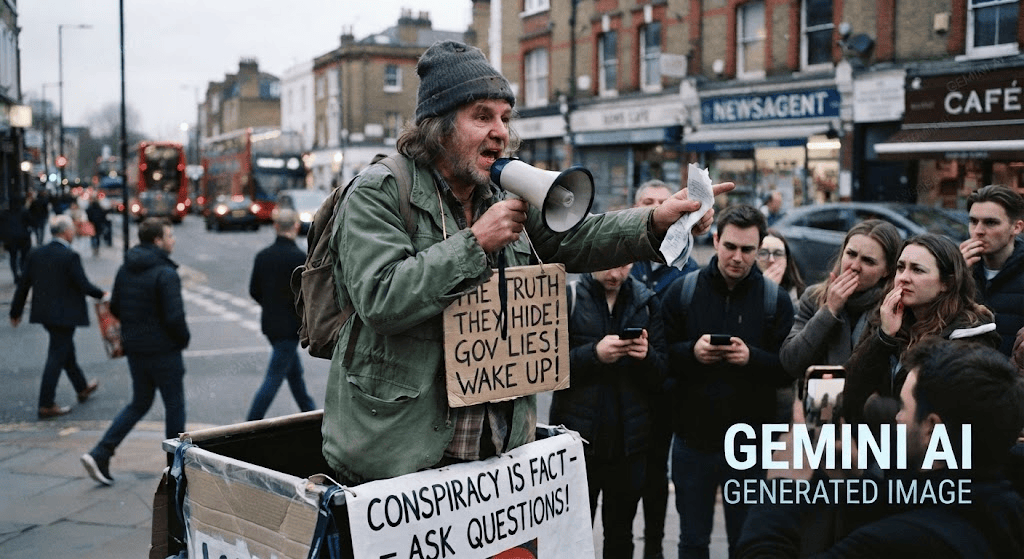
The following is Political Opinion Protected By The First Amendment Of The Constitution of The United States Of America.
I recently engaged a blog that appears to me to be highly centered on alternative facts and conspiracy theorists and it led me to try to explain what conspiracy theories really are, how they affect us all, etc… and here is that effort:
The last one of these that I encountered was centered somewhere in Texas and has long since apparently stopped publishing. I remember that this one from way back when was pretty troll-like and very pig headed refusing to believe anything but what some empty-headed associates pilled into his vacuous brain cavity.
The most recent one that I just encountered this very week is very similar — highly argumentative when trying to justify obviously false narratives or twisted truths but I do respect these kinds of authors and I defend their rights to say what they want to say because this is America and that is what America is all about.
So then— about conspiracy theories and theorists and their effect on us all—-
On the morning of Sept. 11, 2001, Americans watched the World Trade Center burn on live television. Within hours, the country was trying to make sense of what had happened. Who had done it? How had the attacks been possible? Could anyone have known beforehand?
Most Americans eventually accepted the findings of investigators: 19 al-Qaeda hijackers had carried out the attacks.
But not everyone did.
In the years that followed, a different explanation took hold in parts of the country. Some people argued that the government had allowed the attacks to happen. Others said explosives had brought down the towers. Some suspected that officials knew far more than they were admitting.
The claims spread through books, radio programs and, increasingly, the internet. Conspiracy theories have never been confined to the internet, and the people who promote them are not all alike. Some are political activists. Some are entrepreneurs. Some appear to sincerely believe what they are saying. Others have found that alarming claims are a remarkably effective way to build an audience.
The common thread is suspicion—particularly suspicion of people and institutions with power.
America has always been suspicious
There is nothing particularly new about Americans believing in conspiracies.
In the early years of the republic, Federalists and Republicans accused one another of plotting against the country. Freemasons became the target of a major political movement in the 19th century. Catholics, immigrants, bankers and political elites have all, at various times, been portrayed as members of hidden networks working against ordinary Americans.
The Kennedy assassination made conspiracy theories a permanent part of modern political culture.
President John F. Kennedy was killed in Dallas on Nov. 22, 1963. The Warren Commission concluded that Lee Harvey Oswald was the lone gunman. Many Americans never accepted that explanation. A later congressional investigation concluded that Kennedy was probably assassinated as the result of a conspiracy, although it could not determine who else was responsible.
Then came Watergate.
In the early 1970s, reporters Bob Woodward and Carl Bernstein helped uncover a sprawling political scandal that reached into the White House. President Richard Nixon resigned in 1974.
The lesson was not that every government conspiracy theory is true. It was almost the opposite: sometimes powerful people really do lie, conceal information and work together in secret. The challenge is determining when there is evidence and when there is only suspicion.
That distinction has become harder to make in the internet age.
The internet changed the business
There was a time when someone with an unusual political theory needed a publisher, a radio station or a television producer to reach a large audience.
Not anymore.
A person with a phone and an internet connection can now broadcast to thousands of people from a bedroom, garage or home office. If the material catches on, the audience can grow into the millions.
And conspiracy theories are well suited to the internet.
They tend to be dramatic. They promise hidden information. They give viewers villains and heroes. They offer the excitement of discovering something that supposedly powerful people do not want the public to know.
That makes them good content.
A provocative video can generate clicks. A podcast can attract subscribers. A controversial commentator can sell books, memberships or merchandise. Political organizations can use frightening claims to encourage donations.
That does not mean every person making such claims is knowingly lying. In many cases, it is impossible to know exactly what a promoter believes.
But there is an obvious financial incentive to keep an audience interested.
And once someone’s livelihood depends on an audience, backing away from a sensational claim can be difficult.
The appeal of knowing something others don’t
There is another reason these ideas spread.
They can make people feel important.
A conspiracy narrative often divides the world into two groups: the people who understand what is really happening and everyone else.
The people in the first group are supposedly “awake.” They have done the research. They have seen the documents. They have connected the dots.
Everyone outside the group is either uninformed, deceived or part of the problem.
That can be a powerful form of identity.
Online communities built around conspiracy theories can become social communities as much as political ones. People who feel ignored or distrustful of mainstream institutions can find others who share their concerns. They exchange links, videos and personal stories. They reinforce one another’s suspicions.
Eventually, the community itself can become a source of authority.
If a newspaper says one thing but 50 people in an online group say something else, the group may seem more trustworthy to its members.
That is one reason simply telling people that they are wrong often accomplishes very little.
The politics of the hidden enemy
Conspiracy theories can also be useful political tools.
American politics is complicated. Inflation, immigration, wars, crime, technological change and economic inequality have many causes. There are rarely simple answers.
A conspiracy story offers one.
Instead of a complicated collection of economic and political forces, there is a group behind the curtain. Instead of uncertainty, there is a plan. Instead of competing interests, there is a villain.
That can be politically powerful.
The claim that the 2020 presidential election was stolen is a particularly important example. Despite extensive investigations and the lack of evidence establishing fraud on a scale that could have changed the outcome, the allegation continued to circulate. It became a rallying point for millions of Americans and a defining issue within Republican politics.
The consequences extended well beyond social media. The false claim helped fuel anger surrounding the Jan. 6, 2021, attack on the U.S. Capitol and contributed to threats against election workers and officials.
The larger point is that conspiracy theories do not have to be universally believed to have political consequences.
They only need a sufficiently large and committed audience.
When suspicion becomes a problem
A healthy democracy needs skeptical citizens.
Americans should question politicians. Journalists should investigate government agencies. Scientists should challenge established ideas. Whistleblowers should be protected.
Some of the country’s most important revelations began with someone refusing to accept an official explanation.
The problem comes when skepticism becomes impossible to satisfy.
Suppose an official document contradicts a conspiracy theory. The document can be called fake. Suppose an official denies the accusation. That denial can be presented as proof of a cover-up. Suppose journalists investigate and find no evidence. The journalists can then be accused of being part of the conspiracy.
At that point, there is no possible evidence that could change the believer’s mind.
That is very different from an investigation.
An investigation has an endpoint. Evidence can settle the question. A conspiracy narrative can keep expanding.
What it does to government
The effects are not limited to politics.
Government depends on a basic level of public cooperation. People have to believe that election officials are counting votes honestly, that public-health agencies are trying to protect people, that government statistics are produced in good faith and that courts can make decisions without secretly taking orders from political organizations.
Those assumptions are not always justified. Governments have made serious mistakes and committed serious abuses.
But when distrust becomes universal, fixing those abuses becomes harder rather than easier.
Officials may spend their time responding to accusations that cannot be resolved with evidence. Election workers may become targets of harassment. Scientists and public-health employees may receive threats. Journalists can find themselves accused of serving a hidden political agenda simply because their reporting contradicts someone’s preferred explanation.
And ordinary citizens are left with a difficult choice: Whom do they believe?
The deeper problem
Perhaps the most important effect of conspiracy culture is not that it persuades everyone of a particular theory.
It is that it can persuade people that nobody can be trusted.
That is a dangerous place for a democracy.
A country does not need its citizens to agree on everything. Americans have always argued, often loudly. But they need some common ground about how facts are established.
The United States has plenty of real scandals in its history. Watergate happened. Government surveillance programs existed. Intelligence agencies conducted secret operations. Corporations have concealed wrongdoing. Politicians have lied.
Those facts make skepticism reasonable.
They do not make every extraordinary claim true.
The answer is not to demand that Americans blindly trust their government, the media or experts. It is to demand better evidence from everyone—including the people making accusations.
Who has the documents? Can someone else verify them? What evidence would prove the claim wrong? Are there simpler explanations? What does the strongest opposing evidence say?
Those questions are less exciting than a secret plot.
They are also much harder to manipulate.
That may be the real challenge posed by America’s conspiracy culture. The country does not have to choose between blind trust and total suspicion. There is a third option: skepticism that is willing to follow the evidence, even when the evidence leads somewhere unexpected.
This version deliberately uses a less “perfect” rhythm, more concrete examples, and a more conventional newspaper-feature voice while keeping the reporting cautious and evidence-based.
 Lines By Liming