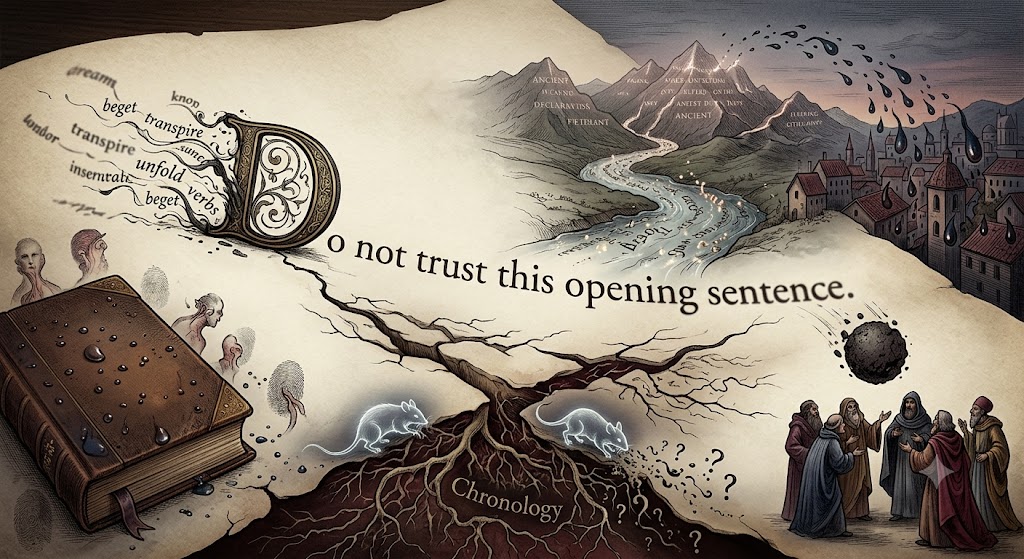
Do not trust this opening sentence.
It arrived after the conclusion and has been walking backward through the alphabet ever since, collecting unborn verbs in its sleeves. By the time you finish reading, it will have become your earliest memory.
The page is breathing again.
Each inhale invents a century.
Each exhale removes one.
Somewhere beneath the paper, invisible animals are chewing through the roots of chronology. They do not eat years. They prefer assumptions. The noise you hear is an empire becoming punctuation.
A period falls from the ceiling.
It lands in the middle of an argument and suddenly everyone remembers a law that has never been written. The books begin sweating. Their margins fill with fingerprints belonging to people who have not yet evolved.
Ink is a migratory species.
Every autumn it leaves the page and darkens the veins of sleeping cities. In winter, statues dream they are children. In spring, declarations bloom inside stones, and mountains begin quoting futures they overheard from rivers flowing uphill.
The librarians pretend not to notice.
They shelve thunderstorms under Philosophy.
They classify eclipses as Footnotes.
They fine anyone returning tomorrow late.
There is a courtroom inside every raindrop.
The judges have no faces.
The witnesses are mirrors covered in moss.
The verdict arrives first, wrapped in smoke. Centuries spend themselves trying to manufacture a crime worthy of it.
Outside, the horizon has folded itself into an origami lung. It inhales birds before they hatch. The eggs remember flying and crack open in the shape of maps. Every border immediately forgets which side it belongs to.
A child draws a circle.
The circle becomes a continent.
The continent develops an accent.
The accent writes a constitution.
The constitution dreams of a forest.
The forest wakes up and votes the paper out of existence.
Do not mistake this for symbolism.
Symbols are only the shadows cast by objects that exist somewhere else.
This is the somewhere else.
Listen carefully.
The vowels are tunneling beneath the consonants.
Soon language will collapse into a sinkhole, exposing an older alphabet made entirely of weather. Rain will become grammar. Wind will conjugate mountains. Lightning will refuse to distinguish between prophecy and memory.
Every sentence is secretly a weather system pretending to be thought.
Watch this one.
It has begun snowing inside the word present.
Individual moments freeze into transparent insects. They crawl beneath your skin carrying tiny lanterns filled with yesterday’s sunlight. Wherever they settle, the future grows another organ.
Someone you’ve never met suddenly remembers you.
Not because of destiny.
Because I misplaced a semicolon.
Entire civilizations have disappeared that way.
An adjective once turned too slowly and a coastline wandered inland for three hundred years. A missing comma taught oceans how to evaporate upward. A metaphor escaped into agriculture, and orchards began producing clocks instead of fruit. The clocks ripened at midnight and released flocks of hours that nested in people’s mouths.
From then on, every promise tasted metallic.
Meanwhile the moon has become editorial.
Night after night it crosses out coastlines with silver chalk, proofreading geography until continents resemble unfinished thoughts. Tides are simply the sea trying to read the corrections aloud.
You think you are reading this blog.
The blog is reading you.
It has reached your peripheral vision already. It is replacing unnecessary memories with unopened windows. Soon your reflection will begin citing passages from conversations that happen next Thursday. Your shadow will arrive ten minutes before your body and politely refuse to explain itself.
Do not interrupt it.
Shadows are excellent historians.
They remember every future the light abandoned.
The paragraph has started growing roots.
They are descending through your screen, through your desk, through the foundations of the building, through fossilized rain, through extinct afternoons, until they reach the soft machinery beneath existence where every unwritten sentence sleeps with its eyes open.
Something is writing there.
Not with ink.
With probability.
Every word it chooses rearranges the architecture of the present. Hallways discover new destinations. Ancestors exchange faces. Children inherit memories that have not occurred. The dead begin editing drafts of the living. Tomorrow develops scar tissue around decisions no one has made.
You are almost finished reading.
Notice how the room has become slightly impossible.
One wall is now remembering another house.
The ceiling contains the weather from next April.
Your heartbeat has quietly adopted a different calendar.
The first sentence is no longer where you left it.
It has entered the future.
It is waiting for us there, pretending to be the reason all of this has already happened.

 LINES BY LIMING
Are you getting positive feedback? chuq
LikeLike
Positive feedback? Yesterday I found the answer asleep inside the pocket of a mirror, where it had mistaken the dawn for a forgotten animal. It refused to count approval or disapproval, because numbers dissolve whenever they touch the tongue of the invisible.
The voices that arrive do not congratulate. They bloom. Each one carries a staircase folded into the shape of a bird, and each bird flies only beneath the roots of trees. I have watched satisfaction remove its gloves to reveal a pair of compasses, forever drawing circles around the place where certainty ought to have been.
If there is praise, it is the kind that rain offers to abandoned keys. If there is reproach, it is merely a chandelier rehearsing how to become snow. Between them hangs a window through which the horizon continuously exchanges masks with an unopened letter.
So I cannot say whether the feedback is positive. I can only report that the moon has begun answering in the handwriting of rivers, and every time the question returns, it arrives carrying flowers that have forgotten the names of their own colors.
LikeLike
But we all know the universal truth is that librarians really do notice everything.
Best wishes, Pete.
LikeLiked by 1 person
Yes, we all know the universal truth is that librarians really do notice everything. They notice the extra comma hiding behind your left shoulder, the bookmark pretending to be a moth, and the thought you almost had three Tuesdays from now. They can hear a book being misremembered from three floors away. When the shelves rearrange themselves after midnight, they don’t ask why—they simply update the catalog. The universe itself is overdue, and somewhere a librarian is patiently waiting for it to be returned with all its pages intact.
LikeLike