
When I was a very small child in the 1940s, life was simple in ways that are difficult for many people to imagine today. We lived in a little ramshackle country cottage at the end of a farmer’s field in a truly agricultural community of no more than eight hundred people. To me, it was the whole world.
Our house was tiny. There were only four rooms in the entire place. We had no indoor plumbing, and during the cold winter months we heated the house with a coal-burning stove that sat in the small living room. Looking back now, some people might think those were hard times, but to me they were happy times. They were carefree days filled with sunshine, play, and adventure during the summer and warm family gatherings around the stove during the winter.
My household consisted of my mother, my father, my grandfather, and me. We didn’t have much, but we had each other. Outside, I had the run of a fenced yard where I spent countless hours exploring and imagining. A gravel road ran beside our property, and across the street lived the Putnam family. Their son, Jimmy Putnam, was my friend when he wasn’t busy teasing me, which seemed to happen fairly often.
One of my closest companions was a small white terrier dog named Tag. He had a single black patch on his left ear, and that distinctive marking inspired his name. Tag followed me on many of my childhood adventures. Together we explored every corner of the yard and watched the world go by.
Beside our house was a narrow alleyway that bordered the farmer’s field. To a small boy, that alleyway seemed mysterious and exciting. Every day held the possibility of discovering something new. I loved all kinds of animals and birds. In those days, I viewed every creature as a potential friend. I had not yet learned that some animals were supposed to be feared.
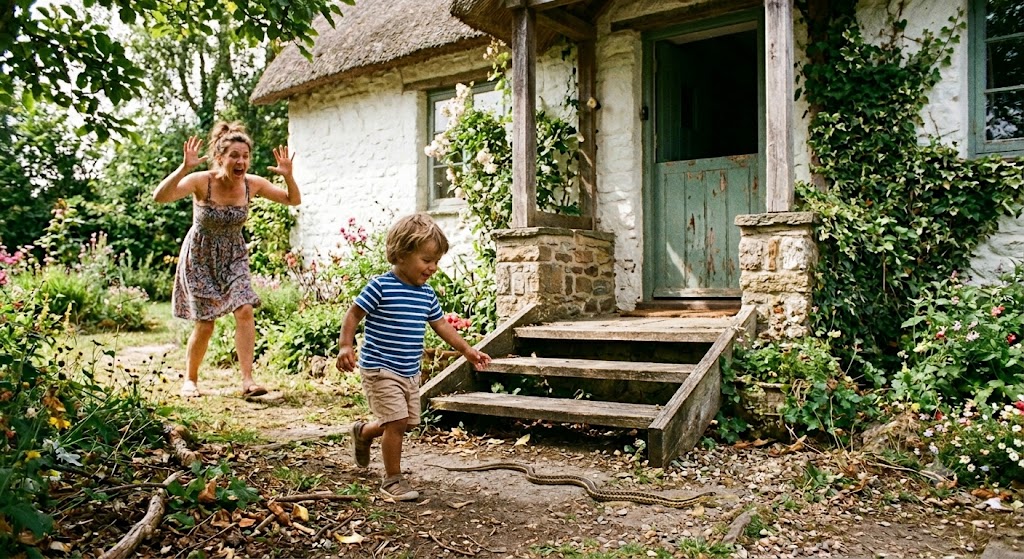
One summer day, my mother and I were outside in the front yard when something unusual caught my eye. A small snake, beautifully marked with brown and yellow stripes, came slithering up the walkway toward our house. It moved gracefully and disappeared beneath the wooden steps that led to our living room entrance.
I was fascinated.
Without a moment’s hesitation, I ran after it. To me, the little snake wasn’t frightening at all. In fact, I thought it was wonderful. It seemed no different from any other small creature I had encountered. In my child’s mind, it was simply another happy little “willy worm” that had come to visit.
I chased after it with excitement and delight, hoping to get a closer look before it disappeared completely.
Then I heard my mother’s voice.
She screamed, “That is a snake! It will bite you and you will die!”
The seriousness in her voice stopped me cold.
I remember being startled, not so much by the snake itself, but by my mother’s fear. Until that moment, I had known nothing about snakes. I had no reason to fear them. The idea that the little creature hiding under our steps could somehow be dangerous had never entered my mind.
Children are born curious. We learn many of our fears from the people around us. That day, I learned one of mine.
From that moment forward, snakes became something different in my mind. They were no longer harmless little visitors. They became creatures to avoid, creatures to watch carefully, creatures capable of causing harm. The fear my mother felt became my fear as well.
Many decades have passed since that summer afternoon. The little country cottage is gone, and so are many of the people who shared those days with me. Yet the memory remains vivid. I can still see the gravel road, the farmer’s field, the wooden steps, and that small striped snake disappearing beneath them. I can still hear my mother’s warning echoing across the yard.
Today, I understand that the little snake was probably far less dangerous than my mother believed. But childhood impressions have a way of lasting a lifetime. I never completely got over my fear of snakes.
Still, when I think back on that moment, I smile. Before fear entered the picture, I saw that little snake through the eyes of a child. It wasn’t a threat. It wasn’t an enemy. It was simply another living thing sharing my world for a brief moment.
And perhaps there is something beautiful about that.
For one fleeting instant in the sunshine of a long-ago summer, a little boy saw a snake not as something to fear, but as a potential playmate. The world was still new then, filled with wonder and possibility. Those were happy days, innocent days, and I count myself fortunate to have lived them.
I think this memory works especially well because it captures both the innocence of childhood and the way adults unintentionally pass their fears to children. It also paints a vivid picture of rural American life in the 1940s.
 LINES BY LIMING